
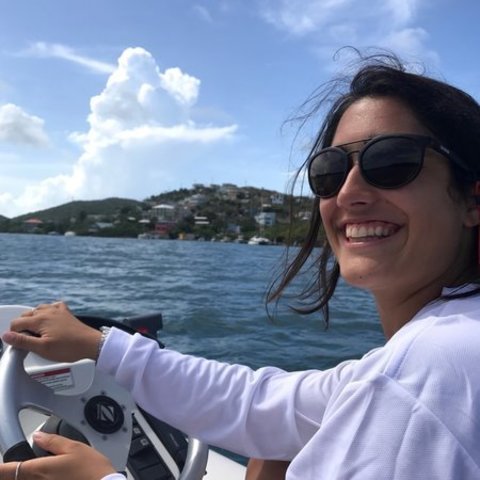
Andrea Contreras started diving when she was 11 years old growing up in Puerto Rico. “Nothing was ever more interesting, or exciting, or wonderful to me than the ocean. I loved diving because I was transported to this world where I was a visitor, and everything was so different, yet still so important to the world I was from. Oceans provide half the planet’s oxygen and they mitigate climate change. Between their value to me and their value to the planet, I knew they were my lifelong passion, even as a child.”
Contreras, BS ’19, had a major turning point when she returned to the Caribbean for a summer to do community-based research in Puerto Rico, the US Virgin Islands and the British Virgin Islands. She taught community members how to collect data by taking photographs that can be used for photogrammetry, in which a large number of images are used to make reliable survey measurements. “When you think about it, local dive shops, and fishermen, and others have way more access to these environments than scientists do. Imagine if they were taking measurements and collecting data? We’d have such a better understanding of how these systems work.” Contreras uses the photos and GIS techniques to create 3D models that tell her about the structural complexity of coral reefs – and by extension, the health of the corals. “Not only that, but so much of a coastal community’s livelihood and culture is based off of these reefs, so it helps us to support the wellbeing of communities, too.”
After she graduates, Contreras will return to Puerto Rico and the British Virgin Islands to collect more information about reef health alongside her community partners. Some of the measurements will help her to write a thesis for a coterminal master’s degree in Earth Systems, which she plans to begin autumn quarter. The Dive Master is also working on getting her scuba diving instructor’s license so she can bring more people to the ocean.
“I’ve taken high school groups into the water, and sometimes it’s their first time even though they actually live right next to the water. Not only do I want to bring the science into the hands of the people from the islands I work on, I’d also like to help them get to know their home better.”
Explore More
-
Data is reshaping our knowledge about many things, including earthquakes: how we measure them, what causes them and how we can better prepare for them.
-
Oceans advanced lecturer Robin Elahi and civil and environmental engineering Assistant Professor Christine Baker share tips for bringing a scientist’s perspective to your next trip to the coast.
-
Gross Domestic Product, the standard metric for measuring national economies, doesn’t account for the valuable services provided by nature. A new approach could help fill the gap.


