
Building bridges
Passionate about “social-ecological leadership,” master’s student Fatoumata Barrie is working to bring more voices into sustainability conversations.
Fatoumata Barrie, MA Sustainability Science and Practice ’25, began her first year at Stanford in fall 2020 amid global uncertainty and widespread calls to address social inequities. She remembers the surge in civic engagement across the U.S. – as well as the lull that seemed to follow.
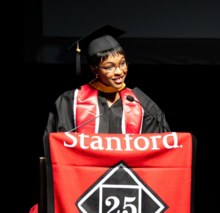
“People were politically activated, but then things receded a bit,” she said. “Being able to continue to advocate and fill in those gaps has been crucial to my time here at Stanford.”
Barrie’s undergraduate studies in sociology provided a background on historical movements and frameworks for social change. She further developed these insights when completing her Sustainability Science and Practice (SUST) coterminal master’s degree with the Change Leadership for Sustainability program, which focuses on preparing students with knowledge and leadership skills to address complex socio-ecological challenges.
“It gave me a different lens to look at some of the issues that I was interested in, like racial equity,” she said. “Bringing in the Earth and climate change raises the stakes, because it’s not just thinking about systemic oppression from one community, it’s placing it within a broader system that helps you recognize that you’re fighting for something much bigger.”
Barrie applied this expanded perspective by leading Stanford’s inaugural Congo Week, which aimed to celebrate Congolese culture while raising awareness of the ongoing environmental and humanitarian crisis in the Democratic Republic of the Congo. The program included student-led teach-ins, speaker panels, art and film showings, and engagement with Congolese leaders.
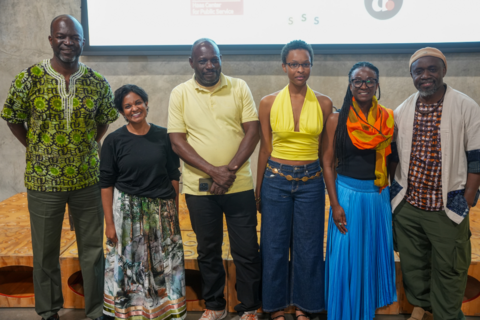
Energized by its success, Barrie scaled up her organizing efforts. She has since coordinated dozens of events and community gatherings focused on racial and climate justice, including a conference that brought together Black student leaders from universities across the country, and an Indigenous and Black solidarity retreat at Jasper Ridge Biological Preserve ('Ootchamin 'Ooyakma).
Barrie intends to stay involved in this work. “This year, I learned the power of connecting with folks and bringing people together,” she said. “Communities have so much to offer each other, so I’m interested in continuing to build bridges.”
During her time at Stanford, Barrie has been encouraged to see a broader range of perspectives included in campus discussions about environmental issues. She hopes that efforts like increased curricula on the conflict in the Congo will continue after she graduates.
“It’s so important to center voices from the global community and make sure they have a seat at the table,” Barrie said. “There’s so much value and so much to learn. I hope to see more of that.”
Explore More
-
Diego Gutierrez, Earth Systems ’25, looks to the ground beneath us to understand how equitable food systems can lift up communities.
-
Alain Pérez, BA Philosophy ’23, MS Sustainability Science and Practice ’24, draws on the ethical principles of philosophy to think critically about sustainability challenges and solutions.
-
Channeling her passion for community building, Emily Blackwell connects groups across campus to improve sustainable practices at events and beyond.


