
Creating India’s digital public infrastructure
Information technology leader Nandan Nilekani discussed how to increase financial inclusion and create a sustainable digital economy in a recent Dean’s Lecture Series event.

Countries around the world face growing challenges to build sustainable economies and support the well-being of all their citizens amid changes in climate, politics, and technology.
Nandan Nilekani, founding chairman of the Unique Identification Authority of India (UIDAI), set out to address this issue by focusing on identification.
During a Stanford Doerr School of Sustainability Dean’s Lecture Series event on May 27, Nilekani shared UIDAI’s work in digitizing India’s economy for 1.4 billion people and ongoing efforts to apply a similar model globally. The Dean’s Lecture Series brings together scholars and thought leaders to discuss the frontiers of research, education, practice, and impact related to an area in sustainability.
“If one asks the question, who are the key people who laid the foundation for modern India, Nandan will be among the few handful of people,” said Dean Arun Majumdar. “He’s now bringing his knowledge, energy, intellect, and network to address the greatest challenge and opportunity of the 21st century: that of sustainability.”
Nilekani is chairman and co-founder of Infosys, an information technology (IT) company that helped make India a global IT powerhouse. He is recognized as a key figure in developing “digital public infrastructure” (DPI), which can expand access to economic opportunities. “If you don’t have an ID – a birth certificate, a driver’s license – you can’t board a bus. You can’t board a train. If a cop stops you, you have nothing to prove who you are. You can’t open a bank account,” Nilekani said. “People were oppressed by the lack of identification.”
Inclusive technology for societal change
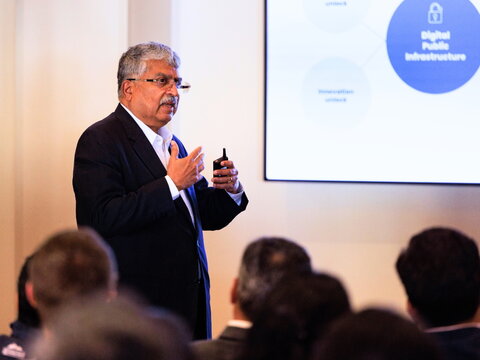
At UIDAI, Nilekani launched Aadhaar, the world’s largest biometric ID system, and the Unified Payments Interface (UPI). Together, these systems created the structure needed to quickly advance India’s economy and reach even the poorest and most rural villages.
“These issues of economic inequity cannot be solved in a traditional way. It can’t be solved by spending money, because we have to do a lot more with a lot less money, and we have to do it faster and achieve a big impact,” Nilekani said.
With Aadhaar, 1.4 billion Indian residents now have digital ID, which they can use to open a bank account. So far, 750 million people have opened accounts and electronically transmitted money through the system without fraud, he said, creating significant economic mobility.
“Why does a vegetable vendor who has a cart on the road want to take digital payments? It increases her safety. The money goes into her bank account, rather than at the end of the day sitting on cash that anybody can come and steal,” he said. “People have found real-life benefits from this technology.”
Guardrails for innovation
Inclusion is one of the core principles when considering how to apply technology for societal change, he added, and the system was created to work with or without access to a phone.
The companies also aimed to balance innovation, regulation, and open architecture that is agile and compatible across payment applications, working with regulators to ensure that guardrails protect data and individuals.
“You could be using any app, and the person you’re giving money to could be using any other app, and it all works seamlessly,” Nilekani said. “When you drive change at scale, you ought to be very strategic about the change you propose and how it brings value to different segments.”
These systems create paths for economic growth and allow India’s residents to improve their lives. For example, rural farmers can use their new ID and digital public infrastructure to access loans to improve their products and then use UPI to accept payments.
Supporting it all is an initiative of the Ministry of Electronics and Information Technology that securely stores credentials, including driver’s licenses, vaccination records, academic records, and ID certificates in the cloud. More than half a billion people are using the system to store around 9 billion documents, Nilekani said.
A global revolution

Nilekani is the co-chair of the G20 taskforce on Digital Public Infrastructure. The G20 comprises 19 countries, the European Union, and the African Union, representing the world’s major economies. Its focus is creating a foundation of global economic stability. Other countries, including Estonia and Nigeria, have adopted the concept of DPI – real-time payment systems and digital IDs – and Nilekani hopes to create a global coalition around these ideas.
“We think that this is the only way we can leapfrog development trajectories,” he said. “We’re entering a world where resources will become scarcer. And unless we take [the] DPI approach, we really can’t get global development going in the way that we want.”
David Studdert, Vice Provost and Dean of Research and professor of law and health policy, joined Majumdar for a dialogue with Nilekani and audience Q&A. Many questions concerned the applicability of the DPI concept to other areas, such as medical records and supporting climate refugees, and how to protect these systems from cyber threats and corruption.
Among other ongoing projects, Nilekani mentioned DPI Climate, which includes a focus on a digital energy grid that enables people with solar-powered homes and batteries to sell excess energy to the grid.
“Fundamentally, our view is that the only way you can change society is to think at scale, but in a thoughtful, inclusive, interoperable way to make everyone participate and drive change, drive through the community to society,” Nilekani said. “We want to take this playbook to the world.”
Explore More
-
A Stanford Doerr School of Sustainability Dean’s Lecture focused on how Stanford University has negotiated its place of influence in U.S. society and world affairs over the course of its history – and why it’s time to renegotiate that place of influence.
-
The latest installment in the Stanford Doerr School of Sustainability’s Dean’s Lecture series welcomed Chief Raoni Metuktire of the Amazon’s Kayapó people to discuss environmental concerns and potential solutions.
-
Founders of the nonprofit organization Amanatari discussed their efforts to facilitate new businesses in the Amazon basin that generate income for local communities without destroying rainforest.


