
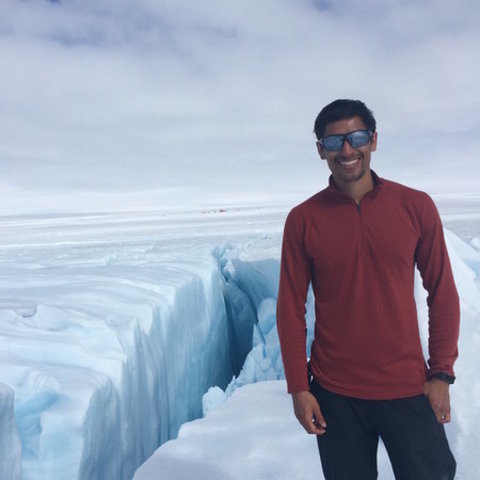
Doing field work in the Arctic wasn’t what Sean Peters expected his graduate education to look like – especially after growing up in desert-dominant Arizona. “Now, I get to spend a few weeks a year doing research in Greenland – camping on an ice sheet, uncomfortable, far removed from anything I was accustomed to before, for up to 30 days at a time,” Peters said. “I was surprised how it all came naturally to me, and that I loved it.”
Alongside assistant professor of geophysics Dustin Schroeder, Peters uses radar to study the Arctic island’s ice sheets. The work is often limited by radars that require transmission over massive, remote areas and cannot produce the temporal resolution the researchers desire. “What if we remove the power-hungry transmitter from the situation and instead use the Sun’s radio emissions as a signal of opportunity to continuously monitor glaciers. That’s what I’m working on.”
Not only does Peters’ research aim to improve the functionality of radar that can help us learn more about ice sheet contributions to sea-level rise, he also finds the work personally satisfying. “Signals are a part of our everyday lives. From FM radio to broadcasting television to WiFi, electromagnetic waves are bouncing around us all the time. I love that I study something that is so prevalent in our lives.”
He hopes to pay his drive for science forward by helping future generations see more scientists from diverse backgrounds. He’s done work mentoring with the Enhancing Diversity in Graduate Education (EDGE) program, El Centro Chicano y Latino’s Frosh Scholars Program and Stanford’s Equity and Inclusion initiatives. In the 2018-19 academic year, he was also a Stanford VPGE DARE (Diversifying Academia, Recruiting Excellence) Fellow.
“Mentorship is so important,” said Peters. “Someday I want to be a professor so I can continue my research while simultaneously continuing to develop the representation of diverse backgrounds in STEM.”
Explore More
-
Earth system science professor Chris Field is co-chair of a National Academies of Sciences, Engineering, and Medicine (NAS) committee analyzing geoengineering strategies that reflect sunlight to cool Earth.
-
The newly named Department of Earth and Planetary Sciences has expanded its expertise in recent years to include extraterrestrial surface processes and atmospheric formation.
-
Rapidly worsening drought and a mandate to bring aquifer withdrawals and deposits into balance by 2040 have ignited interest in replenishing California groundwater through managed aquifer recharge. Stanford scientists demonstrate a new way to assess sites for this type of project using soil measurements and a geophysical system towed by an all-terrain vehicle.


