
Ice for Beginners
Stanford Earth cryopsheric scientists offer a high-level introduction to ice and the role it plays in the Earth system.

We hear about ice when glaciers recede or ice sheets break off, but what are the processes governing these changes? What role does ice play in the behavior, evolution, and stability of the Earth system?
These were among the questions asked and answered by Stanford Earth cryospheric scientists who presented a symposium on Understanding Ice to the Stanford community in April 2018. The symposium honored James B. Case, '50, a glacial surveyor and expert in photogrammetry who donated his glacier map collection to Stanford Libraries in 2017.
The history of Western mapping of glaciers and ice began with Abraham Ortelius’s map of Iceland in 1587, according to Julie Sweetkind-Singer, head of the Branner Earth Sciences Library, who used examples from the collection to show the evolution of cartographic representation of ice over time.
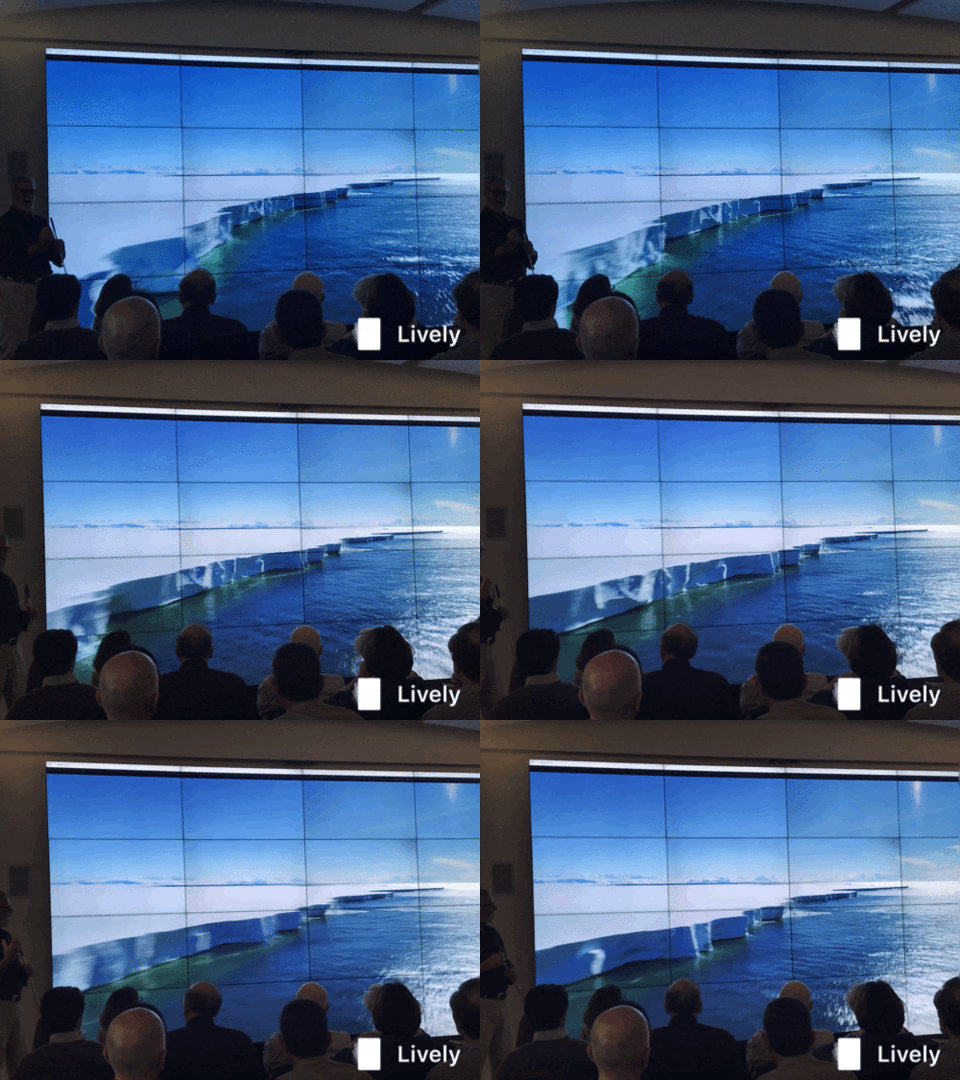
Students and faculty from across the university then received a crash course on the fundamentals and current state of cryospheric science from Dustin Schroeder, assistant professor of geophysics, and Rob Dunbar, the school’s W. M. Keck Professor—two veteran leaders of scientific missions to Antarctica. Schroeder and Dunbar are among half a dozen Stanford Earth faculty who take an interdisciplinary approach to studying ice sheets, glaciers, sea ice and their role in the Earth system.
Schroeder detailed how ice penetrating radar works and what it can teach us about the past, present, and future behavior of ice sheets and glaciers. His Radio Glaciology research group aims to develop solutions for revealing large areas of ice sheets over long periods of time with models that include all of the physics, processes, and conditions that regulate glacial behavior.
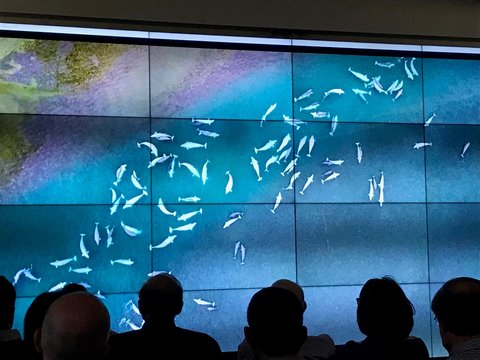
Dunbar shared new findings on the dynamic behavior of Antarctica’s ice sheet in the past and discussed the constraints these findings place on forward-looking models of sea level and ice retreat at both poles. His research involves high resolution studies of climatic and oceanic variability during modern times as well as over the past 50 to 12,000 years. His work in Antarctica is designed to assess the impacts of climate change on Southern Ocean ecosystems.
Jenny Suckale, an assistant professor of geophysics who takes a computational approach to understanding complex multi-phase flows, concluded the event by outlining the physical processes governing ice sheet dynamics. Satellite imagery has helped scientists understand that, instead of melting continuously along the edges, ice sheets lose most of their ice through arterial drainage routes that connect the center of the ice sheet directly to the ocean. Meltwater generation and percolation at the scale of individual sand grains can affect continental scale ice dynamics, Suckale explained.
For more information about Stanford Earth research on the cryosphere, please see the Understanding Ice website.
Explore More
-
Magnets are essential to the world's electrical devices, but within the last 40 years, engineers have struggled to improve them. New research indicates how the use of nanotechnology and an ultra-efficient material can make magnets more powerful, efficient and affordable.
-
Field sees the big picture and distills complex detail into a cohesive whole.It’s no wonder the U.S. tapped him for leadership of the U.N.'s top climate change organization.
-
Extinct lake landforms provide clues of climate change over millions of years and inform our understanding of rainfall patterns and water management in the arid American West.


