
Summit explores collaborative solutions to Southeast Asia’s ‘paradox of sustainability’
Four hundred experts in policy, academia, business, and science met to explore greater collaboration between the U.S. and Southeast Asia to fulfill the fast-growing region’s competing promises of economic growth and greater sustainability.

Southeast Asia faces a “paradox of sustainability,” said Gita Wirjawan, a visiting scholar in the Precourt Institute for Energy and former Minister of Trade for the Republic of Indonesia, as he teed up the Southeast Asia Summit on Prosperity and Sustainability held May 19 at Stanford University.
The region is home to 700 million people across 12 countries with a collective gross domestic product exceeding $4 trillion. It is also rich in biodiversity, energy, and agricultural and marine resources. Together, these factors position Southeast Asia for greater economic leadership and a critical role in global sustainability efforts, Wirjawan said. But the opportunities for economic growth and increased sustainability are in tension with one another.
“Progress across the world – but particularly in Southeast Asia – really depends on our integration of perspectives about energy and the environment. We can’t solve the energy problem without solving the environmental crisis,” said Chris Field, the Perry L. McCarty Director of the Stanford Woods Institute for the Environment. “The issues of energy security, food security, and economic security are intimately linked in a way that can’t be separated.”
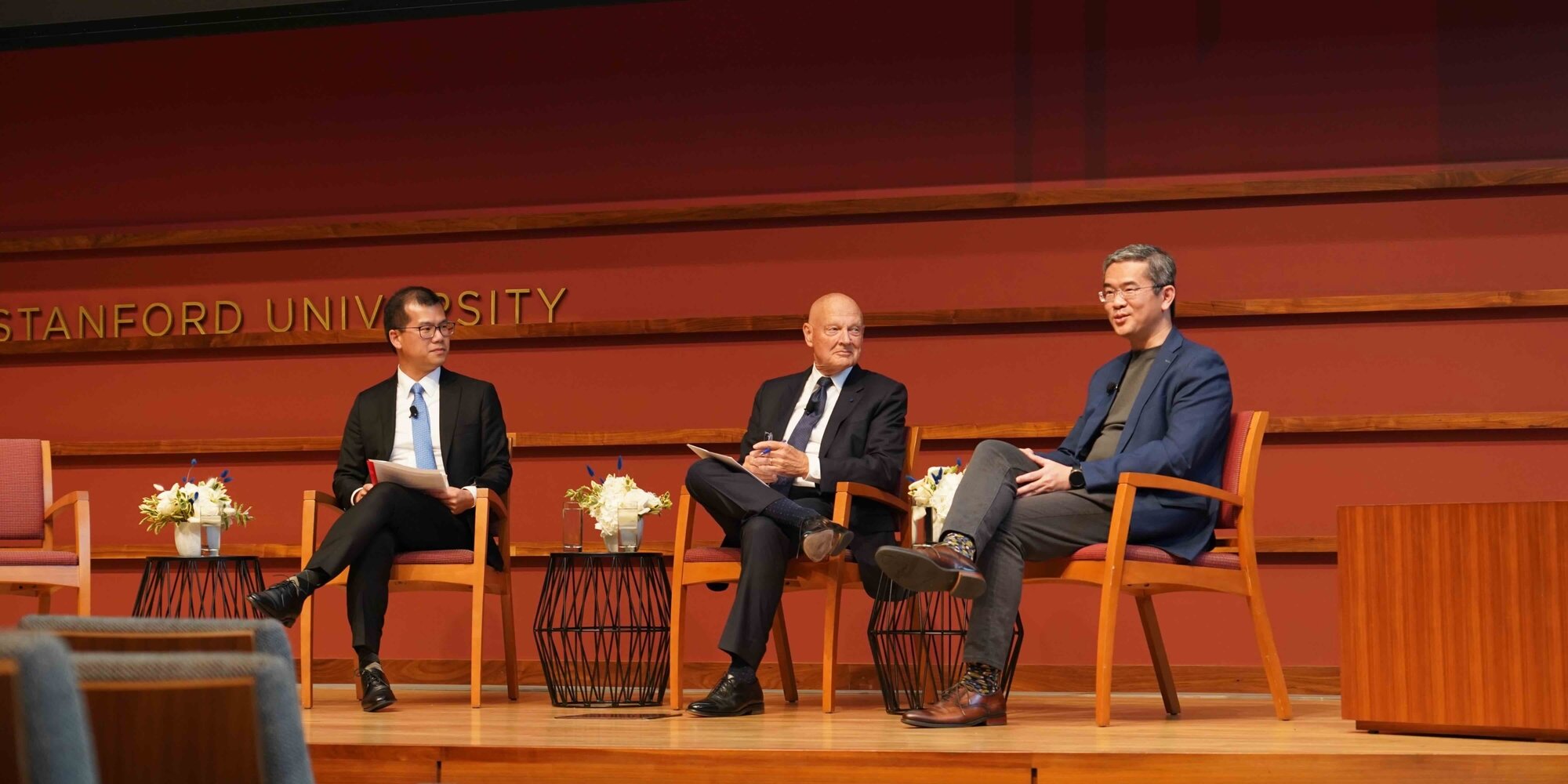
The Stanford Doerr School of Sustainability and its two institutes, Precourt and Woods, hosted the summit to identify and amplify opportunities to make the most of Southeast Asia’s vast energy, economic, and environmental resources. Over 400 guests attended, with featured keynote speakers including Susilo Bambang Yudhoyono, the former president of the Republic of Indonesia; former U.S. Secretary of State Condoleezza Rice, the Tad and Dianne Taube Director of the Hoover Institution; and Nobel laureate and former U.S. Secretary of Energy Steven Chu, the William R. Kenan, Jr. Professor at Stanford, among other leaders.
“The world is facing a storm of crises. Climate disruption, energy shocks, and food shortages are affecting both developed and developing countries. Southeast Asia sits right in the middle,” said Yudhoyono. “This is the challenge of our time, and it is not theoretical. It affects how people live, work, and survive every day. I believe Southeast Asia is ready to step forward.”
The region’s population is now twice that of the U.S. and 60 million people will enter the job market in the next decade, said Lew Chuen Hong, chief executive of Infocomm Media Development Authority, which regulates Singapore’s telecom industry and develops digital infrastructure. Speaking during a panel focused on Southeast Asia’s future energy needs, Lew said, “We cannot ignore the fact that economics drives everything.” Southeast Asia today relies heavily on fossil fuels, he observed, but technology such as using AI to manage the electric grid and shift energy demand could help countries change their energy mix and “bend the economics curve.”
Seeking collaborative solutions
Arun Majumdar, dean of the Doerr School of Sustainability, delivered a keynote that emphasized the important role Stanford and other U.S. research-focused academic institutions can play in Southeast Asia’s economic and environmental evolution.
“How can Stanford collaborate with the people and institutions in Southeast Asia to address key issues related to security, to prosperity, to sustainability and to address resilience to climate change?” Majumdar asked rhetorically. “Stanford is proud of our culture of open inquiry to pursue audacious ideas, to take risks,” he added. “Taking bold steps is in our DNA.”
Majumdar highlighted the school’s recent first steps toward forming a new center focused on sustainability in Southeast Asia. The current mission for this proposed center, Majumdar said, is to create a sustainable world collaboratively. As a leader in research and education, Stanford must engage with the talent in Southeast Asia and empower people with knowledge, critical thinking skills, and a scientific toolbox to make a positive and tangible impact on the world. “What happens in Southeast Asia matters to all of humanity,” he said, “and to the planet.”
Guiding better policies
In a far-ranging dialogue, Rice and Majumdar touched on policy, diplomacy, history, economics, research, and the important place of academia in realizing sustainability in Southeast Asia. Rice discussed prospects for greater partnership between U.S. and Southeast Asian leaders in policy, industry, and academia.
The one-time Stanford provost said she sees the role of the university as twofold: first, creating knowledge through research and scholarship, and second, disseminating that knowledge through education. “I hope that it is recognized how essential U.S. universities have been in the creation of knowledge,” Rice said. “You can take almost any major breakthrough technologically and find that there was a university someplace at its inception in the fundamental research side.”
Rice added that she does not think it is the university’s job to solve all problems. Large economic and environmental challenges must be addressed politically, by people granted democratic power to solve them, she said. Universities should, therefore, provide light – not “heat” – to guide policymakers toward solutions. “Then, hopefully, [academia] can take that knowledge to partners in the political system who can take advantage of our research to make policy better,” she said.
Above all, Rice stressed seizing an opportune moment in history to build better and stronger partnerships between U.S. academia and policy, business, and sustainability communities in Southeast Asia.
“In Southeast Asia, the problem of sustainability is a real and urgent one,” Rice said. “I think this is a moment of opportunity, and it’s relatively early, but not too early, to get these elements right. That’s why I think this is a region that deserves our attention and our partnership.”
Explore More
-
A collaboration between Stanford researchers and Indonesian organizations aims to capitalize on aquatic food sources to improve nutrition, food security, and livelihoods.
-
The World Bank president discussed why he sees efforts to end poverty and spread prosperity as inseparable from issues related to climate change, conflict, pandemics, and food security in a conversation with leaders from the Hoover Institution and the Stanford Doerr School of Sustainability.
-
President Joko Widodo of Indonesia spoke as part of the Stanford Doerr School of Sustainability’s Dean’s Lecture series, where he discussed sustainability in Indonesia and the needs of the developing world.


